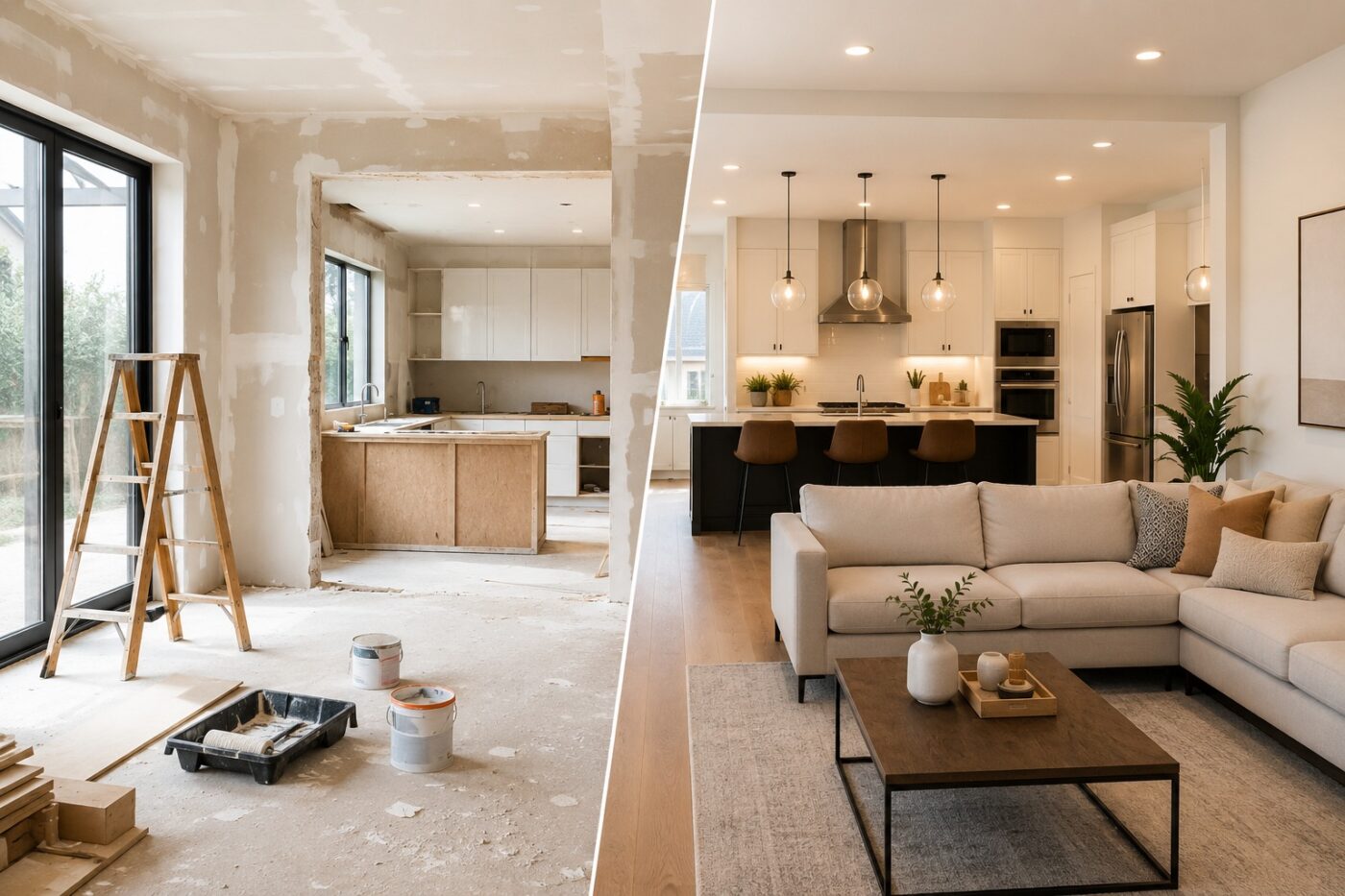
Introduction — Why Renovation Budgets Often Get Out of Control
A home renovation rarely becomes expensive because of one dramatic mistake. More often, the budget slips away through a series of smaller decisions: an overlooked repair, a material upgrade, an extra contractor visit, or a delivery delay that costs more than expected.
Imagine starting a renovation with a carefully calculated $40,000 budget. A few weeks later, contractors discover damaged plumbing, the flooring costs more than anticipated, and several seemingly minor improvements have been added to the project. None of these expenses appears particularly serious on its own, yet together they can create a substantial financial shortfall.
The good news is that renovation budget overruns are often manageable, even when they cannot be prevented entirely.
The key is to approach renovation spending as an ongoing process rather than a one-time estimate. A clear scope of work, realistic contingency planning, transparent contractor agreements, and regular financial reviews can help homeowners recognize problems before they become overwhelming.
This guide explains how to avoid budget overruns during renovation, from identifying potential risks before construction begins to tracking expenses and making difficult financial decisions when costs start rising.
1. Why Renovation Projects Go Over Budget
Renovation budgets are built on assumptions about the condition of a property, the amount of work required, material prices, and the time needed to complete the project. When those assumptions prove inaccurate, actual costs can begin moving beyond the original estimate.
Understanding where these differences come from makes it easier to prevent them.
1.1. Incomplete Estimates and Hidden Expenses
A contractor may provide a quotation for installing new flooring, but the price might not include removing the existing covering, repairing the subfloor, disposing of waste, or installing finishing accessories.
Similarly, a kitchen estimate may cover cabinets and countertops while excluding electrical modifications, plumbing connections, or delivery charges.
These omissions are not always deliberate. Sometimes the scope has not been defined precisely enough for the contractor to provide a complete quotation.
Homeowners can reduce this uncertainty by requesting itemized estimates and asking which activities are specifically excluded. A price that appears unusually attractive deserves closer examination, especially when competing quotations contain more detailed descriptions.
1.2. Unforeseen Conditions and Changing Decisions
Renovations frequently reveal problems that were concealed behind walls, beneath flooring, or inside existing building systems.
Damaged pipes, deteriorated wiring, moisture problems, and structural defects may require additional work before the planned improvements can continue. These discoveries can be particularly disruptive when the original budget has little room for unexpected repairs.
Another common source of overspending is changing decisions after construction starts.
Replacing a previously selected material with a premium alternative may seem affordable. However, the change can also affect installation requirements, delivery schedules, and related construction activities.
A project can therefore exceed its budget even when the original estimate was reasonably accurate.
1.3. Delays and Accumulating Costs
Time also affects renovation expenses.
When materials arrive late or contractors cannot work in the planned sequence, homeowners may face additional labor charges, equipment rental costs, or temporary accommodation expenses.
The financial impact depends on the contract and the circumstances. A fixed-price agreement might protect against some scheduling-related charges, while other costs remain the homeowner's responsibility.
The important distinction is between unavoidable project uncertainty and preventable financial decisions. Hidden defects cannot always be predicted, but incomplete estimates, uncontrolled upgrades, and poorly coordinated work can often be managed more effectively.
2. Define Your Renovation Scope Before Starting
One of the most reliable ways to control renovation spending is to decide what the project must accomplish before contractors begin work.
Without a defined scope, renovation plans tend to expand. A homeowner replacing kitchen cabinets may decide to change the flooring, add lighting, relocate appliances, and update an adjoining dining area. Each improvement may make sense individually, but the combined work can push the project far beyond its original financial limits.
2.1. Separate Essential Work From Optional Improvements
Start by identifying improvements that are necessary for safety, functionality, and the long-term condition of the property.
Repairing a leaking pipe, addressing hazardous wiring, or correcting water damage generally takes priority over installing premium fixtures or changing decorative finishes.
This does not mean cosmetic improvements are unimportant. It means they should compete for funding only after essential requirements have been considered.
A useful approach is to define three spending priorities: work that must be completed, improvements that would significantly enhance the home, and upgrades that can be postponed without affecting basic functionality.
For instance, replacing damaged bathroom waterproofing may be essential, while upgrading to a more expensive vanity could remain optional.
When financial pressure develops, this distinction provides a clear basis for deciding what to change.
2.2. Finalize Decisions That Affect Multiple Trades
Some design choices have consequences far beyond their visible appearance.
Moving a kitchen sink can require plumbing modifications, cabinet changes, and a different countertop configuration. Relocating lighting may affect wiring routes and ceiling finishes. Changing floor materials can alter finished floor heights and door clearances.
These decisions are usually easier to accommodate before construction begins.
Homeowners should therefore confirm room layouts, major fixture locations, material specifications, and technical requirements early enough for contractors to price the work accurately.
The completed scope does not need to predict every hidden condition. It should, however, establish a clear reference point against which future changes can be evaluated.
2.3. Prevent Scope Creep
Scope creep describes the gradual expansion of a project beyond its originally agreed boundaries.
A $450 lighting upgrade, $800 flooring change, and $650 cabinetry improvement add $1,900 to a renovation. Their combined impact may be significant even though none seems especially expensive.
Before approving an additional feature, consider whether it solves an actual problem, whether it can be installed later, and what other expenses it may trigger.
Keeping optional improvements separate from necessary work allows homeowners to enjoy greater flexibility without losing control of the original renovation objectives.
3. Inspect Your Home to Identify Potential Problems
A renovation budget is only as reliable as the information used to prepare it.
Homeowners planning extensive work should understand the property's condition before committing to major purchases or construction agreements. Although a preliminary inspection cannot reveal every concealed defect, it can identify warning signs that deserve further investigation.
3.1. Assess the Structure and Building Systems
Cracks that suggest movement, uneven floors, deteriorated structural components, and evidence of previous water damage may require professional evaluation.
Electrical and plumbing systems deserve similar attention. An older distribution panel, insufficient electrical capacity, corroded pipes, or inadequate drainage can complicate improvements that initially appear straightforward.
Consider a bathroom renovation planned primarily around new tiles and fixtures. If the existing plumbing is close to failure, replacing it before installing new finishes may be more economical than reopening completed walls later.
The purpose of an inspection is not to identify every possible improvement. It is to establish which existing conditions could affect the planned work and whether additional technical investigations are justified.
Structural alterations and safety-critical installations should be assessed by appropriately qualified professionals.
3.2. Investigate Moisture and Hazardous Materials
Water stains, persistent dampness, peeling finishes, and unusual odors can indicate problems that extend beyond the visible surface.
Before covering affected areas with new materials, the underlying source of moisture should be investigated. Otherwise, new flooring, cabinets, or wall finishes may become damaged after installation.
Older buildings may introduce additional risks involving hazardous materials. Products containing asbestos or older lead-based coatings can require specialized handling when renovation work would disturb them.
For example, the U.S. Environmental Protection Agency's asbestos guidance recommends professional assessment of suspected asbestos-containing materials before disturbing them. The relevant requirements and historical building practices vary between countries.
Homeowners should not attempt to identify hazardous materials through appearance alone or undertake potentially dangerous removal work without qualified assistance.
3.3. Use Inspection Findings to Improve the Budget
An inspection becomes financially useful when its findings influence the project plan.
If a specialist identifies a likely plumbing replacement, the associated expense should be estimated and included in the main budget. It should not automatically be treated as an unexpected cost to be paid from contingency funds.
Where uncertainty remains, homeowners can request further investigation, obtain provisional pricing, or adjust the contingency reserve to reflect the risk.
Spending money on targeted inspections can be worthwhile when the findings help prevent extensive rework or poorly informed financial commitments.

4. Create a Detailed Renovation Budget
A renovation budget should explain not only how much money is available but also where it will go and which costs remain uncertain.
A single figure, such as $50,000 for a complete renovation, offers little protection against overspending unless it is supported by a realistic breakdown of the work.
4.1. Organize Expenses Around the Actual Project
Begin with the project's main cost categories and divide them into individual activities where practical.
A whole-home renovation might involve demolition, structural repairs, plumbing, electrical work, flooring, wall finishes, fixtures, labor, professional services, and waste disposal.
For each activity, consider the complete cost of delivery and installation rather than the advertised price of the main product.
New flooring, for example, may involve removal of the existing covering, surface preparation, underlayment, installation, trim, and disposal fees.
Permits, inspections, transportation, temporary utilities, and applicable taxes should also be accounted for when relevant.
The more closely the budget reflects the actual construction process, the easier it becomes to recognize omissions and compare contractor proposals.
4.2. Distinguish Estimated Prices From Confirmed Commitments
Early renovation budgets often contain allowances rather than final prices.
An allowance of $3,000 for bathroom fixtures represents a spending target. It does not establish what the selected products will actually cost.
Once fixtures have been chosen and supplier prices confirmed, the budget should be updated. When a purchase order or contract is accepted, the amount becomes a financial commitment.
This distinction is particularly important for projects planned several months in advance, when material prices and product availability may change.
Homeowners should identify uncertain amounts rather than treating every preliminary estimate as guaranteed.
4.3. Establish Financial Boundaries
Each budget category needs a reasonable spending limit, but those limits should reflect the importance of the underlying work.
Essential electrical repairs should not be underfunded simply to preserve a premium finishing allowance. Conversely, spending more on decorative products should require a deliberate decision about where the additional money will come from.
A useful budget separates three amounts: the cost of planned work, a reserve for unforeseen conditions, and the total funding available.
For example, a project with a $40,000 base budget and a $6,000 contingency requires $46,000 in available funding if the full reserve is to be maintained.
The contingency should not be counted again as part of the $40,000 planned work. Keeping these amounts separate avoids creating a misleading picture of available funds.
A detailed breakdown also prepares homeowners for a more important task: monitoring whether the renovation is likely to finish within those limits.
5. Compare Contractor Quotes and Understand Your Contract
Choosing a contractor based exclusively on the lowest quotation can create expensive problems later.
Two contractors may offer different prices because they have interpreted the project differently, included different materials, or made different assumptions about preparation and finishing work.
A meaningful comparison starts with a consistent description of what each contractor is expected to deliver.
5.1. Compare Equivalent Proposals
Provide contractors with the same drawings, specifications, material requirements, and description of the work.
Then compare the quotations by scope rather than total price alone.
Suppose one contractor quotes $8,000 for a bathroom renovation and another quotes $9,200. The cheaper proposal may exclude waterproofing preparation, waste removal, and some plumbing connections. Once those charges are added, the apparent saving could disappear.
Request clarification whenever a quotation contains broad descriptions such as "bathroom installation" or "complete finishing" without identifying the specific work involved.
A good proposal should make it reasonably clear which materials, services, quantities, and responsibilities are included.
Price matters, but so do qualifications, relevant experience, references, insurance where appropriate, and the contractor's ability to deliver the agreed result.
5.2. Understand the Pricing Arrangement
A fixed-price contract typically establishes an agreed amount for a defined scope of work. It can make costs more predictable when requirements are clear, although excluded work, approved changes, and certain unforeseen conditions may still create additional charges.
A cost-plus arrangement generally involves paying eligible project expenses together with the contractor's agreed fee or markup. This can provide flexibility when the scope is uncertain, but the final price may be harder to predict.
For cost-plus agreements, clear expense records, approval thresholds, and appropriate spending controls are particularly important.
Neither approach guarantees protection against every budget overrun. The contract must explain how uncertain work, allowances, price changes, and additional expenses will be handled.
5.3. Establish Payment and Documentation Rules
Before signing, review the payment schedule, completion expectations, responsibilities for purchasing materials, and procedures for approving additional work.
Where practical, payments can be linked to verifiable milestones rather than arbitrary dates. The contract should also clarify what documentation must be provided before payment and how defects or incomplete items will be addressed.
Avoid making financial commitments based solely on verbal assurances.
A properly documented agreement can reduce misunderstandings, but contract enforceability, payment protections, cancellation rights, and professional licensing requirements vary by jurisdiction.
Keeping copies of quotations, contracts, invoices, receipts, and written approvals creates a clear record of what has been agreed and paid.

6. Build a Realistic Renovation Contingency Fund
Unexpected repairs can arise even when the renovation has been thoroughly planned. A contingency fund provides a financial buffer for situations that could not reasonably be priced before construction.
Without this reserve, one significant discovery may force homeowners to abandon important improvements or seek additional financing.
6.1. Decide How Much to Reserve
A commonly used planning starting point is 10–20% of the estimated renovation cost, although the appropriate amount depends on the condition of the property and the uncertainty involved.
This range is also reflected in renovation guidance from This Old House. It is a practical guideline, not a universal rule or a guarantee that the reserve will cover every problem.
A relatively straightforward cosmetic renovation may present fewer hidden-condition risks than a major refurbishment of an older property involving demolition and replacement of building systems.
For a $40,000 renovation, a 15% reserve equals $6,000. The total planned funding requirement would therefore be $46,000.
If $46,000 is the maximum amount the homeowner can afford, the project should be designed around a base budget that leaves room for contingency rather than committing the entire amount to planned improvements.
6.2. Define What the Reserve Can Cover
Contingency funds should primarily address genuinely unforeseen expenses.
Discovering damaged subfloor materials beneath an existing bathroom is a possible example. Replacing unsafe wiring found during demolition may be another.
By contrast, known delivery fees, planned waste removal, and previously identified repairs belong in the main renovation budget.
A contingency fund should not become an informal allowance for premium fixtures or additional decorative features.
When a problem arises, obtain an explanation of the necessary repair, its proposed cost, and any alternatives before authorizing spending, except where immediate protective action is required.
6.3. Monitor the Reserve Separately
Suppose a project begins with a $6,000 contingency and an unexpected plumbing repair costs $2,500.
The remaining contingency is $3,500.
That balance should be visible in the financial tracker and reconsidered as construction progresses.
If the reserve is consumed early, the homeowner should be more cautious about approving optional work, even if the project has not yet exceeded its total available funding.
Unused contingency money is not a problem to solve. It is a successful outcome of managing uncertainty, and it can remain available until the project is complete and outstanding obligations are settled.
7. Control Changes During the Renovation
Not every modification is a mistake. Some changes are necessary because hidden conditions emerge, technical requirements become clearer, or the original solution proves unsuitable.
The financial risk comes from allowing changes to proceed without understanding their consequences.
7.1. Evaluate More Than the Visible Price
A homeowner may decide to replace a standard bathtub with a walk-in shower. The new fixture might appear only slightly more expensive, but the modification could require drainage work, waterproofing changes, additional tiling, and a revised installation schedule.
The proper question is not simply, "How much does the new product cost?"
It is, "How much will the entire change cost, including related work and delays?"
This is especially important when work has already been completed. Removing newly installed materials to accommodate a design change can be much more expensive than making the same decision during planning.
When a proposed improvement is optional, compare its value with the additional cost and consider whether it could be completed later.
7.2. Document and Approve Change Orders
A change order records an agreed modification to the original project.
It should describe what is changing, the resulting price adjustment, and any effect on the completion schedule.
The American Institute of Architects' guidance on change orders illustrates this principle in formal construction agreements. Residential arrangements may be simpler, but the importance of documenting scope, price, and time remains.
For example, if a contractor identifies damaged pipes behind a wall, the homeowner should receive a clear repair proposal before additional work begins whenever circumstances permit.
The proposal should distinguish necessary work from optional improvements and explain whether the change replaces any already budgeted activity.
An agreed modification should then be reflected in the expense tracker. Otherwise, several small approvals may accumulate without appearing in the projected final cost.
Urgent measures needed to prevent immediate damage or protect safety may require a different authorization procedure. That procedure should be discussed in advance and documented appropriately.
7.3. Maintain a Clear Decision Record
A short change log can be remarkably useful.
For each modification, record its description, approval date, additional or reduced cost, and effect on the schedule.
This makes it possible to see not only how much the project has changed but also why.
More importantly, it discourages decisions made under pressure without adequate financial review.

8. Manage Material Purchases Without Overspending
Material purchasing involves a balance between price, performance, availability, and installation requirements.
Buying the cheapest product is not necessarily economical, particularly if it wears out quickly, requires additional installation work, or proves unsuitable for the intended conditions.
Equally, selecting premium products throughout a renovation can consume funds needed for essential construction.
8.1. Make Important Selections Early
Major materials should be selected early enough for contractors to confirm their suitability and account for installation requirements.
Tile dimensions, flooring thickness, door specifications, and fixture sizes can influence other parts of the project. Late substitutions may require additional preparation or changes to completed work.
Homeowners can reduce this risk by identifying a preferred product and a technically suitable alternative before construction reaches the installation stage.
The alternative should be evaluated for performance, compatibility, total cost, and availability rather than appearance alone.
8.2. Calculate Quantities and Full Purchase Costs
The amount shown on a supplier's price tag may not include delivery, unloading, accessories, cutting waste, storage, or return charges.
For example, ordering flooring requires accurate measurements and a suitable allowance for installation waste. The allowance depends on room geometry, product type, layout pattern, and manufacturer recommendations.
Ordering too little can delay work and generate additional delivery costs. Ordering too much may leave expensive unused stock.
Product batch consistency also matters. Some tiles and finishes can vary slightly between manufacturing batches, making later matching difficult.
Before purchasing, confirm the required quantities with the installer, review return conditions, and check whether materials can be stored safely until needed.
Coordinating orders may reduce transportation costs, but buying excessively early can increase the risk of damage, storage problems, or changes in project requirements.
Good purchasing decisions are those that support the planned work at a predictable total cost.
9. Prevent Delays That Increase Renovation Costs
A delayed renovation does not automatically become more expensive, but delays often create opportunities for additional costs.
Some homeowners must extend temporary accommodation. Others face equipment rental charges, repeat deliveries, or contractors who need to return after their scheduled work period.
The first step in controlling these risks is understanding how the different construction activities depend on one another.
9.1. Build a Sequence That Reflects the Work
Demolition, inspections, structural repairs, electrical and plumbing installations, surface preparation, and finishing generally need to follow an appropriate technical sequence.
For instance, completing decorative wall finishes before confirming concealed electrical and plumbing work may result in those surfaces being reopened.
A realistic schedule should account for product lead times, necessary inspections, drying or curing periods, and contractor availability.
Not every task needs to happen consecutively, and some activities can overlap safely. An experienced contractor or project manager should help establish which work can proceed simultaneously without causing conflicts.
9.2. Coordinate Deliveries and Contractors
A delivery delay can affect several trades if the missing material is required before work can continue.
Likewise, materials that arrive long before installation may require storage and additional handling.
Regular discussions about upcoming activities can prevent many of these problems. Contractors should know when the site will be ready, which products are required, and whether any design decisions remain unresolved.
If the schedule changes, request a revised completion forecast and identify the financial consequences.
For example, extending temporary accommodation by two weeks at an illustrative rate of $1,500 per month could add approximately $750 if the arrangement allows proportional billing. Actual charges depend on the rental agreement.
The objective is not to eliminate all scheduling uncertainty but to avoid preventable delays and understand the cost of those that occur.
10. Track Renovation Spending Throughout the Project
A budget that is never updated becomes increasingly unreliable as construction progresses.
A homeowner might believe there is $10,000 left to spend because that amount remains in the bank account. However, $6,000 may already be owed to contractors, with another $5,000 of essential work still unfinished.
In that situation, the project is heading toward a funding shortfall even though the account has not yet been depleted.
This is why effective renovation tracking must consider future obligations, not just money already paid.
10.1. Use a Consistent Expense Tracking System
A spreadsheet is sufficient for many residential projects.
Each transaction should identify its category, description, supplier or contractor, approved cost, payment status, and supporting invoice or receipt.
Larger projects may benefit from more detailed software, but complexity is less important than maintaining accurate records.
Use consistent definitions:
Budgeted costs represent the amounts allocated to planned work.
Paid expenses represent money already disbursed.
Unpaid commitments represent remaining amounts owed under accepted orders, contracts, approved changes, or received invoices that have not been paid.
Forecast uncommitted costs represent work and purchases still required but not yet included in those commitments.
An invoice that has been received but not paid should not be added again as a separate future cost if it is already included in unpaid commitments.
This separation is essential to avoid double counting.
10.2. Forecast the Final Cost, Not Just Current Spending
The financial question that matters most is how much the renovation is expected to cost when all work is complete.
A practical cash-based forecast is:
Forecast Final Cost = Paid Expenses + Unpaid Commitments + Estimated Remaining Uncommitted Costs
For example, consider the following renovation tracker.
| Expense Category | Original Budget | Paid | Unpaid Commitments | Remaining Uncommitted | Final Forecast |
|---|---|---|---|---|---|
| Labor | $12,000 | $7,000 | $3,500 | $1,500 | $12,000 |
| Materials | $10,000 | $6,000 | $2,500 | $2,000 | $10,500 |
| Fixtures | $4,000 | $1,500 | $1,500 | $1,000 | $4,000 |
| Other costs | $4,000 | $1,000 | $500 | $2,500 | $4,000 |
| Total | $30,000 | $15,500 | $8,000 | $7,000 | $30,500 |
Illustrative amounts. The categories exclude contingency funds, which should be monitored separately.
The homeowner has paid only $15,500, but the forecast indicates a total project cost of $30,500.
Compared with the original $30,000 budget, the projected overrun is $500.
Recognizing that difference before construction finishes makes it possible to adjust spending while options remain available.
10.3. Review the Budget Regularly
For many residential renovations, a weekly financial review is a practical starting point. More complex projects or periods of intensive purchasing may require closer monitoring.
Review new invoices, outstanding commitments, approved changes, and the remaining cost of unfinished work. Update uncertain estimates when contractors or suppliers provide more reliable information.
Pay particular attention to repeated differences in the same category. A single small overrun may be manageable, while several underestimated activities can quickly change the project's financial position.
It also helps to compare the latest forecast with both the original budget and the total funding limit.
These figures answer different questions. The original budget shows how far the cost has moved from the plan, while the funding limit shows whether sufficient money remains to complete the work.
10.4. Watch for Financial Warning Signs
A project deserves closer review when major purchases are approved without updated prices, contractors regularly request additional payments, or the remaining contingency is being consumed earlier than expected.
Another warning sign is a budget category that appears underspent only because essential work has not yet been ordered.
A useful financial review should always consider what remains to be completed.
When the forecast begins exceeding the available budget, homeowners should address the problem before entering new agreements or placing additional nonessential orders.

11. What to Do When Your Renovation Is Going Over Budget
Discovering a projected overrun can be stressful, especially when much of the renovation has already been completed.
However, immediately choosing cheaper materials or canceling work is not always the right response.
The first step is to understand whether the problem involves an unexpected essential repair, optional upgrades, underestimated costs, or a temporary mismatch between payment timing and available cash.
11.1. Reassess the Financial Position
Start by updating the final cost forecast.
Include payments already made, unpaid commitments, necessary remaining work, and any approved changes. Identify which expenses are still estimates and which amounts cannot be reduced without contractual consequences.
Suppose a project with a $40,000 base budget is now expected to cost $44,000.
If the homeowner has a separate $6,000 contingency, the project may still be financially manageable. Nevertheless, using $4,000 of that reserve would leave only $2,000 for further unforeseen expenses.
The decision therefore depends not only on the size of the overrun but also on how much work remains and how much uncertainty is left.
11.2. Reduce Discretionary Spending First
Before compromising essential work, review improvements that are not necessary for safety or basic functionality.
A premium countertop may have a suitable lower-cost alternative. Additional decorative lighting might be postponed. Custom storage could be installed after the main renovation is finished.
The timing matters, however.
Deferring a feature that requires reopening finished walls or floors may create more expense later. The best candidates for postponement are improvements that can be completed independently without substantial rework.
Check whether cancellation fees, deposits, or special-order commitments would reduce the expected savings.
Cost cutting should never involve bypassing necessary waterproofing, using unsuitable electrical components, ignoring structural concerns, or avoiding required safety procedures.
11.3. Choose the Appropriate Response
Different situations call for different financial decisions.
| Situation | Practical Response |
|---|---|
| Hidden damage is discovered | Verify the repair and consider legitimate contingency funding |
| Selected materials exceed their allowance | Compare suitable alternatives and total installation costs |
| A contractor proposes additional work | Request documented scope, price, and schedule implications |
| Optional improvements threaten the budget | Reduce or postpone work that can be completed later |
| The contingency reserve is nearly depleted | Reassess remaining risks and restrict discretionary spending |
| Available funding cannot cover essential work | Review a reduced scope, financing options, or a controlled pause |
If completing the planned work is no longer affordable, continuing without a realistic financial plan can create more serious problems.
A carefully managed pause may be appropriate, but it should not leave the property exposed to water damage, unsafe installations, or other hazards.
Before suspending construction, review contractual obligations, outstanding payments, protective work, and possible restart costs with the contractor.
Additional borrowing should also be evaluated cautiously. Interest, fees, repayment obligations, and affordability can make an apparently simple financing solution more expensive over time.
The objective is to preserve a safe, functional result while preventing a temporary cost problem from developing into a longer-term financial burden.
12. Practical Example: How Budget Control Prevents Overspending
Consider a hypothetical homeowner renovating a kitchen, bathroom, and several interior rooms.
The renovation is expected to cost $40,000, with an additional $6,000 contingency reserve. The homeowner therefore has $46,000 available but intends to complete the planned work for approximately $40,000.
All figures in this example are illustrative rather than representative market prices.
12.1. The Original Budget
The project budget is divided into the following categories.
| Renovation Category | Planned Cost |
|---|---|
| Kitchen renovation | $12,000 |
| Bathroom renovation | $9,000 |
| Flooring | $6,000 |
| Electrical improvements | $5,000 |
| Interior finishing | $4,000 |
| Other planned expenses | $4,000 |
| Total | $40,000 |
The contingency fund is maintained separately and is not included in these figures.
The homeowner has already confirmed the principal design decisions, obtained contractor quotations, and identified optional features that could be postponed if necessary.
12.2. Unexpected Problems Appear
During bathroom demolition, workers discover deteriorated plumbing connections and moisture-damaged subfloor materials.
A qualified contractor assesses the issue and provides a $2,500 estimate for the necessary repairs.
Because the damage needs to be addressed before new waterproofing and flooring are installed, the homeowner approves the additional work and records the expense against the contingency reserve.
Around the same time, the homeowner considers upgrading kitchen finishes for an additional $1,200.
If the original scope remains unchanged and both additional expenses are accepted, the projected construction cost becomes $43,700.
That amount is still within the $46,000 funding limit, but it would consume a substantial portion of the reserve.
Rather than approving both expenses, the homeowner reviews the priorities.
12.3. Adjusting the Plan
The essential bathroom repair is retained.
The premium kitchen upgrade is rejected in favor of the originally planned materials, avoiding the proposed $1,200 increase.
The homeowner also identifies optional lighting worth $600 and decorative finishing features worth $400 that have not yet been purchased or contractually committed.
These improvements can be postponed without disrupting the essential renovation.
The revised calculation is straightforward.
| Budget Adjustment | Amount |
|---|---|
| Original base budget | $40,000 |
| Unexpected bathroom repair | +$2,500 |
| Postponed lighting | −$600 |
| Postponed decorative features | −$400 |
| Revised final forecast | $41,500 |
The premium kitchen upgrade does not appear as an added cost because it was considered but never approved.
After removing $1,000 of optional improvements, the remaining planned scope costs $39,000. Adding the essential $2,500 repair results in the same $41,500 forecast.
12.4. Understanding the Financial Result
The renovation is now projected to finish $1,500 above the original $40,000 base budget.
However, it remains $4,500 below the total funding limit of $46,000.
Of the original $6,000 contingency, $2,500 has been allocated to the unexpected bathroom repair, leaving $3,500 of contingency uncommitted.
The additional $1,000 in available funds comes from optional improvements that were removed from the planned scope.
Together, these amounts explain the $4,500 difference between available funding and the revised forecast.
If the homeowner had accepted the premium kitchen upgrade and retained both optional improvements, the projected cost would have been $43,700.
The revised plan is therefore $2,200 less expensive than that alternative.
12.5. What This Example Demonstrates
The homeowner did not eliminate the unexpected repair and did not finish at the original estimated price.
Nevertheless, the project remained within the available funding limit, essential repairs were completed, and the contingency reserve was not exhausted.
The important decisions occurred before additional discretionary spending became unavoidable.
This illustrates the central principle of renovation budget control: success does not always mean spending exactly the original estimate. It means understanding financial commitments, responding early to changing conditions, and completing the project without allowing costs to become unmanageable.

13. Final Checklist to Keep Your Renovation on Budget
Financial discipline should continue from the first estimate until the final contractor payment. The following checklist summarizes the decisions that matter most.
Before Renovation
- ☐ Define essential work and identify upgrades that can be postponed.
- ☐ Investigate property conditions that could affect the project scope.
- ☐ Prepare a detailed budget that includes foreseeable additional expenses.
- ☐ Establish a separate contingency fund appropriate to the project's risks.
- ☐ Compare contractor proposals and confirm written contract terms.
During Renovation
- ☐ Track payments, unpaid commitments, and projected remaining costs.
- ☐ Review the budget regularly and update the final cost forecast.
- ☐ Approve changes only after considering their total financial impact.
- ☐ Coordinate material purchases and construction schedules to avoid preventable rework.
- ☐ Protect contingency funds from unnecessary discretionary spending.
Before Final Payment
- ☐ Confirm that completed work and approved changes meet the agreed requirements.
- ☐ Reconcile invoices, outstanding balances, and remaining contractual obligations before final settlement.
A checklist is most useful when it influences real decisions. If an item reveals a problem, address it before proceeding to the next financial commitment.
Conclusion — Stay in Control of Your Renovation Budget
Renovation budget overruns are not always caused by poor planning. Hidden conditions, changing requirements, and unavoidable technical problems can increase costs even on well-managed projects.
What homeowners can control is how those problems are anticipated, documented, and handled.
A clear renovation scope, detailed financial estimates, appropriate contingency reserves, and carefully reviewed contractor agreements create a strong foundation. Regular expense tracking and disciplined approval of changes help maintain that control throughout construction.
When costs rise, reviewing the full financial forecast and adjusting nonessential work can prevent a manageable problem from becoming a serious financial setback.
Ultimately, avoiding budget overruns during renovation is not simply about choosing cheaper materials or reducing spending. It is about making informed decisions, protecting essential work, and using available funds in a way that supports safety, quality, and long-term value.
Frequently Asked Questions (FAQ)
1. What Is the Most Common Cause of Renovation Budget Overruns?
There is no single cause that applies to every project. Incomplete estimates, unforeseen repairs, changes in scope, and poor expense monitoring are all common contributors.
Budget overruns often develop through several smaller increases rather than one major event. Detailed planning and consistent financial reviews can help identify these problems before they accumulate.
2. How Much Extra Money Should I Budget for Unexpected Renovation Costs?
A contingency reserve of approximately 10–20% of the estimated renovation cost is a common planning starting point, although some projects may require more.
For a $30,000 renovation, a 15% reserve would be $4,500, bringing the total funding requirement to $34,500.
The appropriate amount depends on building age, existing conditions, project complexity, and the uncertainty that remains after inspections.
3. How Can I Keep Contractors From Going Over Budget?
Begin with detailed written quotations and a clearly defined scope of work.
The contract should explain payment arrangements, exclusions, and procedures for approving additional work. Review invoices regularly, document modifications, and request an updated cost forecast when the scope changes.
These measures improve financial transparency, although they cannot eliminate all costs arising from unforeseen conditions.
4. What Should I Do if My Renovation Exceeds the Original Estimate?
First, determine why the estimate has increased and recalculate the expected total cost, including outstanding commitments and unfinished work.
If necessary, review whether the contingency fund can cover legitimate unforeseen expenses. Consider postponing optional improvements or selecting suitable alternatives.
If sufficient funding is unavailable, discuss a reduced scope or controlled pause with the contractor rather than continuing without a realistic financial plan.
5. Is a Fixed-Price Renovation Contract Always Better?
Not always.
Fixed-price contracts can provide greater cost predictability for clearly defined work, but excluded activities, approved changes, and certain unforeseen conditions may still require additional payment.
Cost-plus contracts can offer flexibility when the scope is uncertain, although they require careful expense monitoring and clear approval arrangements.
The most suitable agreement depends on project requirements, financial risks, and applicable local rules.
6. How Often Should I Review My Renovation Budget?
A weekly review is a reasonable starting point for many residential renovations.
During periods involving major purchases, multiple contractors, or significant changes, more frequent monitoring may be appropriate.
Each review should consider money already paid, unpaid commitments, expected remaining expenses, and the available contingency reserve.
7. Can I Reduce Renovation Costs Without Sacrificing Quality?
Yes. Homeowners can often save money by simplifying designs, comparing equivalent materials, coordinating purchases, and postponing optional upgrades.
The focus should be on removing unnecessary expenses rather than reducing the quality of essential construction.
Structural safety, electrical installations, plumbing reliability, waterproofing, and compliance with applicable requirements should never be compromised merely to achieve a lower price.